The Moon
Waxing Crescent
6% lit. Below the horizon — you'll have to wait for it to rise.
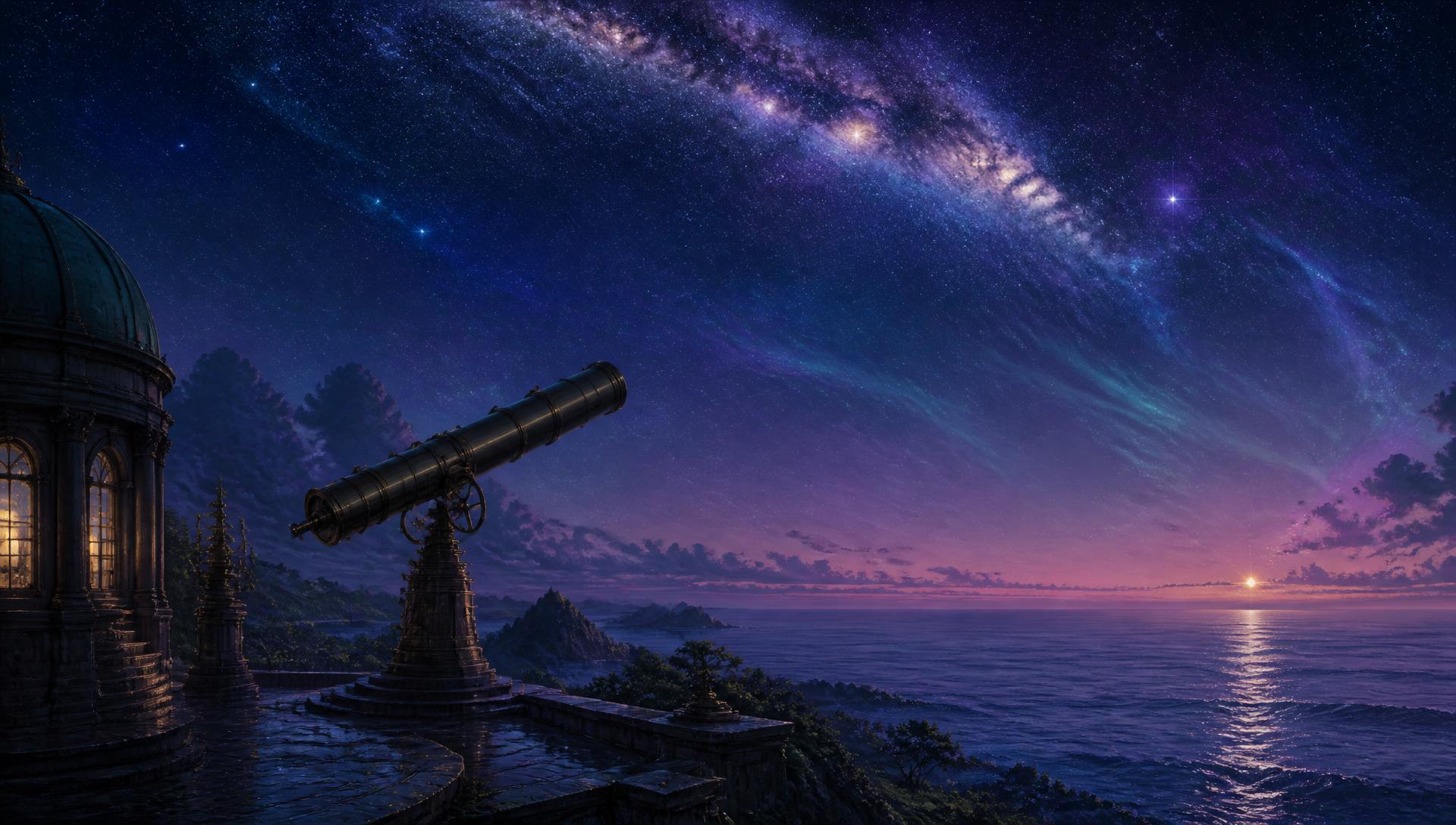
The Observatory · Open every night
Neverland Academy keeps a brass telescope on every common-room balcony. Here, we teach you the shapes hidden in the stars — the mythology behind them, the physics that makes them shine, and one very small light on the western horizon that has a story all its own.
The Observatory
Every star below is a real star, projected from a modern catalogue in its correct position for your latitude and this exact moment. Tap a star for its name and distance. Toggle the constellation lines to trace the shapes.
Tap a star to learn its name and distance. Toggle constellation lines to trace the shapes.
Waxing Crescent · 6% litSun altitude: -52.8°Latitude 51.48°, LST 4.8h
Tonight over Royal Observatory
The Moon
6% lit. Below the horizon — you'll have to wait for it to rise.
Wandering stars
Best constellation right now
near the zenith in the west. Sits between Cassiopeia's W and the Pleiades cluster. Rich in the Milky Way.
The Second Star Observatory
Neverland's Planetarium
Six cinematic tours across the real night sky. The camera glides between the brightest stars while a calm voice tells you what you're looking at. Best in a dark room, with sound on.
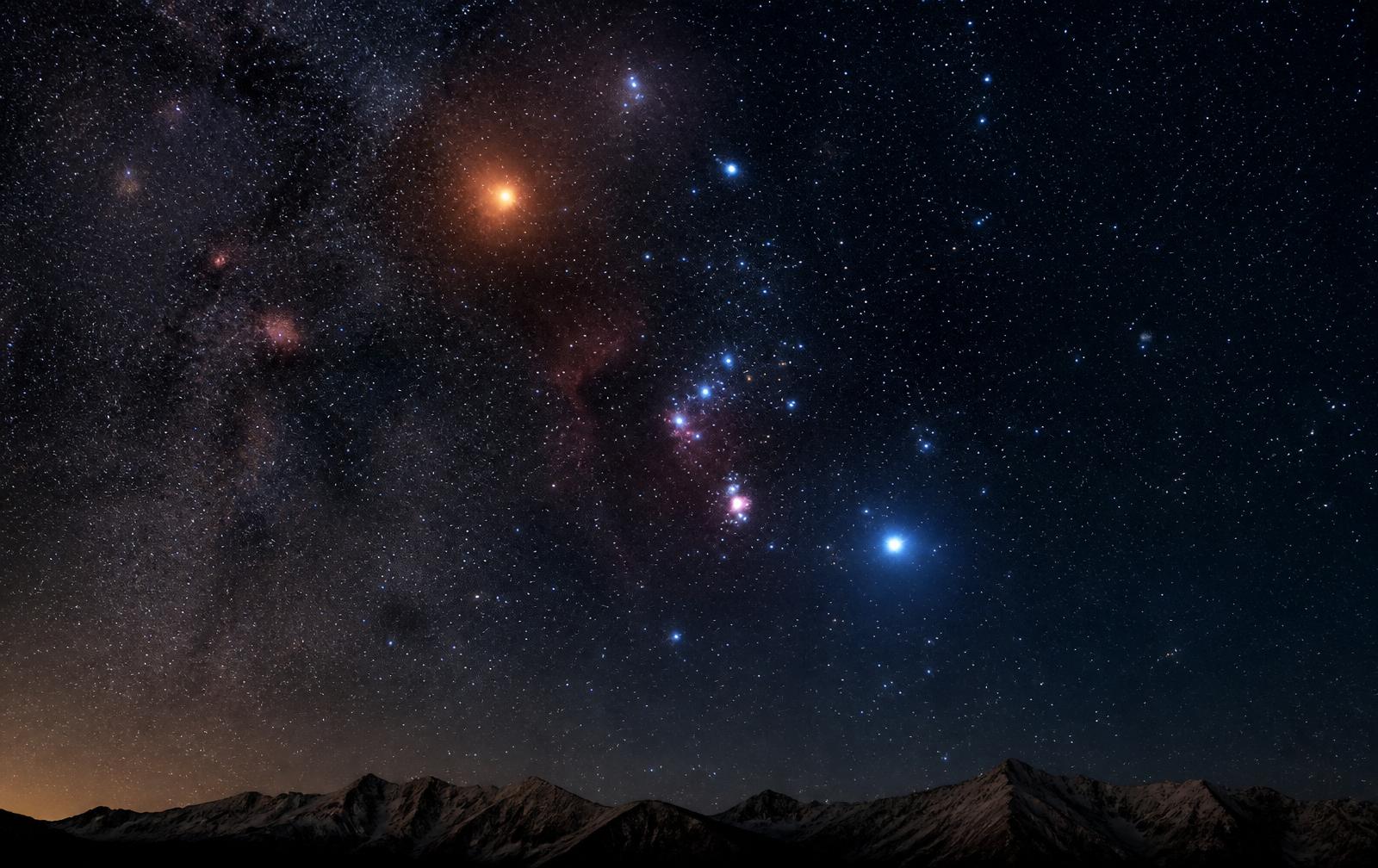
Full-screen. Escape exits at any time.
The special star
No catalogue has ever charted it. It only appears to those who know where to look — just past the brightest star in the west, low over the sea. Follow it, and you leave the ordinary sky behind.
Every night the observatory points at that empty patch of sky and brings back three small lights to carry you through the evening: one film, one story, one long lullaby.
Follow itThe Compendium
Once you know these, the whole sky opens up. Each card shows the real star pattern — positions and brightnesses drawn straight from the catalogue.
Winter · Both
A great hunter of Greek myth. Three stars in a perfect row form his belt, with red Betelgeuse on his shoulder and blue-white Rigel at his foot — a supergiant so bright it outshines every star for hundreds of light-years around it.
On winter evenings, look south for three bright stars in a straight line. That's Orion's Belt. Everything else builds out from there.
Spring · Northern
Seven of its brightest stars form the Plough — the easiest shape in the whole sky. The two right-hand stars of the bowl point straight to Polaris, the North Star.
Look north. Four bowl stars, three handle stars. It never sets from most of Europe or North America.
All year · Northern
Its brightest star is Polaris, the North Star. Every other star in the northern sky wheels around it through the night — Polaris alone barely moves.
Follow the two pointer stars at the end of the Plough's bowl. They aim directly at Polaris, roughly one hand-span away.
Autumn · Northern
A vain queen placed in the sky by the gods, so that she circles the pole upside down half the year as punishment.
A bright zig-zag W (or M, depending on the hour) sitting opposite the Great Bear across the North Star.
Summer · Northern
The little harp of Orpheus, whose music was so beautiful that even the stones stopped to listen. Vega is one of the closest bright stars to us — its light takes only 25 years to reach your eye.
On summer nights, find the brightest star nearly overhead. That's Vega. The harp hangs below it as a small parallelogram.
Summer · Northern
A great swan flying south along the Milky Way. Deneb marks its tail — a supergiant so distant that the light you see tonight left before humans built the Colosseum.
Look for a bright cross in the summer Milky Way. Deneb is its brightest star, at the top of the cross.
Summer · Both
The scorpion that killed Orion. The two are placed on opposite sides of the sky so they never appear at the same time. Antares — 'rival of Mars' — glows deep red at its heart.
Low in the south on summer nights, look for a giant fish-hook of stars with red Antares at its curve.
Spring · Both
A crouching lion. The reversed question-mark of stars forming his head and mane is called the Sickle. Regulus, the Little King, sits at the base of the Sickle.
Look east in early spring for a bright backwards question mark. Regulus is the bright dot at the bottom.
Winter · Both
The charging bull. Orange Aldebaran is his eye, and the tiny cluster of the Pleiades sits on his shoulder — seven sisters born of moonlight.
Follow Orion's Belt up and to the right. You'll hit orange Aldebaran and a V-shaped face of stars called the Hyades.
Winter · Both
The mortal Castor and immortal Pollux, twin brothers so devoted that Zeus placed them together in the sky so they'd never be parted.
Above and left of Orion, two bright stars sit close together. Those are the twins' heads.
Winter · Both
Orion's faithful hunting dog. Its collar is Sirius — the brightest star in the entire night sky, and one of the closest to Earth.
Follow Orion's Belt down and to the left. The first blazing star you hit is Sirius. It often twinkles fiercely.
Autumn · Northern
A princess chained to a rock and rescued by the hero Perseus. Just off her shoulder floats the Andromeda Galaxy — the most distant thing your naked eye can see.
Find the Great Square of Pegasus in autumn. Andromeda strings east from its top-left corner.
Autumn · Northern
The hero who rescued Andromeda. He holds the severed head of the gorgon Medusa — marked by the eerie 'demon star' Algol, which winks dim every three days.
Sits between Cassiopeia's W and the Pleiades cluster. Rich in the Milky Way.
Autumn (south) · Southern
The smallest constellation in the sky, but the surest guide south. Sailors have steered by it for centuries. It graces the flags of Australia, New Zealand, Brazil, and more.
Only visible from the southern half of the world. Four bright stars in a tilted cross.
Summer · Both
The centaur archer, drawing his bow. His arrow points straight at the heart of our galaxy — the exact direction of the supermassive black hole 26,000 light-years away.
Low in the south on summer nights, look for a bright teapot shape. Steam rises from its spout — that steam is the Milky Way.
Lessons from the observatory
Every other star wheels around it through the night, tracing perfect circles. If you can find Polaris, you can find any direction — and find your way home.
Polaris sits almost exactly above Earth's axis of rotation, so from our viewpoint it stays fixed while the rest of the sky spins.
Stars don't really twinkle. Their light is shaken as it passes through moving layers of air high above your head. Planets look steadier because they're closer and appear as tiny discs, not points.
Sirius's light took nine years to reach you. Deneb's took over two and a half thousand. When you look up, you are quietly looking back in time.
The Andromeda Galaxy, faintly visible to the naked eye, is 2.5 million light-years away. Its light left before our species existed.
Astronomers use magnitude — smaller number, brighter star. Sirius shines at −1.5, Vega at 0, Polaris at 2, and the faintest stars your naked eye can see are around 6.
That soft band arching across a dark-country sky isn't a cloud. It's the disc of our own galaxy, seen edge-on. We live inside it, about two-thirds of the way from the centre.
The moon doesn't change shape — you're only ever seeing the half lit by the sun. As it orbits Earth, that lit half turns towards or away from us.
Mercury, Venus, Mars, Jupiter, and Saturn all shine like stars — but they drift against the fixed background night after night. The ancient Greeks called them planētēs — wanderers.
The seven stars of the Plough have been a plough to English farmers, a bear to the Greeks, a coffin to the ancient Arabs, and a great dipper to the Lakota. The stars are the same. The stories belong to us.